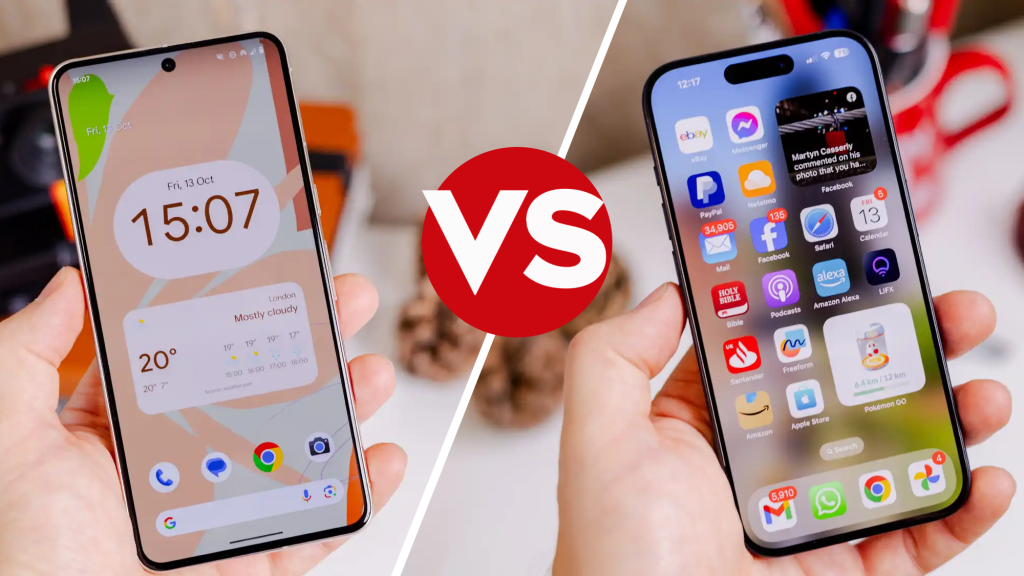
This has been a regular occurrence over the years, at dinner tables, in different chats, and people talking in breaks at an office. They usually end up talking about those shiny gadgets they keep in their pockets. Maybe it all started with a joke about the “green bubble” spoiling the group’s chat vibe, or it may be the hesitation of a person who is in a career store and wondering if changing to the other side means that all their photos will be lost.
The battle between Apple’s iOS and Google’s Android can be considered the most important advanced technology debate of our generation.
The choice was very straightforward a decade ago. One would choose an iPhone if one wanted the simplest option and Android if one was after customization. However, the difference has faded as Android has been made more appealing to users and iOS has introduced some great features like widgets and options for customization that were previously exclusive to Google’s platform. Nowadays, when someone asks whether the iPhone is better than Android, it is no longer a question of ideology but rather a fight for the top hardware.
Here, we are not going to be biased by brand loyalties. We are going to look deeply and comprehensively into three metrics that really affect your everyday life: Camera, Battery, and Performance with data. When you have finished reading, you will be able to identify the flagship that truly deserves to be in your pocket, whether you are a content creator, a mobile gamer, or a power user who is trying to finish some work.
Round 1: Camera Comparison – Capturing the World
For the vast majority, their smartphone is the only camera that they have. Mobile phone makers are aware of that, and that is why physical camera bumps keep getting bigger, and they bombard us with tons of marketing materials that use photography buzzwords. However, if we put aside the marketing, what are the real differences between the products?
Dispelling the Megapixel Myth
Through a very strict examination of the specifications, one may reasonably conclude that in terms of the camera, the Android smartphone is a clear winner. To illustrate, the company that makes Samsung Galaxy S24 Ultra comes out with a very impressive 200-megapixel sensor, while the main sensor of iPhone 15 Pro Max is only 48-megapixels. Does this mean that Android captures 5 times more pixels? Not really.
You should not always interpret higher numbers to mean better photos. A camera comparison emphasizes that software processing is equally fundamental to hardware specifications. Many Android manufacturers count on the pixel binning technique, where 4 pixels are put together to create one larger virtual pixel so as to collect more light. Apple, on the other hand, relies on its Photonic Engine mechanism, which combines several uncompressed pictures at a pixel level to bring perfect texture and color.
The fact is, 200 megapixels are unnecessary for the everyday person. It is mostly the image processing capability of the device that wins the game. The photos taken using Android smartphones typically get saturated and “punchy” immediately, and thus are almost ready for Instagram. On the other hand, iPhone pictures tend to be more conservative and warm, thus giving a softer and more neutral base for editing.
Sensor Size and Quality
It is more important to consider the physical size of the sensor than the number of pixels. Bigger sensors can gather more light from the scenes; hence, your photos will contain less grain (noise). Both teams have really pushed themselves in this area and they have managed to fit almost 1-inch sensors into their thin phone cases.
Although it often appears that the best Android phones have a bigger sensor than Apple on paper, in reality the light of the day differences are negligible. The real test comes when the sun goes down.
Night and Low-Light Photography
A mode for night has completely changed the game of photography through a mobile phone. Here is the part for computational photography, which is about using AI to enhance the images.
Apple’s method of pictures in the dark is mostly referred to as “natural”. By using an iPhone, the shadows and overall feeling of a dark scene are preserved. It desires that the night looks like the night.
The Android high-end models terribly aggressively pursue the light. To “illuminate” the scenes more, they sometimes cut the level of white. The scenes are so bright as if one had pulled color from the darkness. If it is your desire that everything be visible, then with most probability, Android will be your choice. If, on the other hand, it is the desire to record the mood of a dinner by candlelight without making it look like a brightly lit office, then the iPhone will be the winner.
Video Capabilities
Although camera alone still is a very close competition between the two, with the video feature the winner is quite clear. For video recording on the go, the iPhone is still one of the best. Absolutely, none of the current phone models can rival the seamless, dynamic range, and stability that you get in an iPhone. With features like “Cinematic Mode,” the iPhone even looks like the movie-making professionals who are doing the focusing between the scenes and the objects, thus the technology of rack-focusing is mimicked pretty accurately.
Just by the way of spectacular specs, Android is also impressive, for example, the 8K recording and “Director’s View”, the latter making the front and back camera usable for recording simultaneously. But in reality, the features are not as mesmerizing as Apple’s in this department because the latter can provide video without shutter lag or panning jitters.
Social Media Integration
We can’t talk about cameras without also referring to the destinations of the pictures. The deciding factor is probably social media for the younger generations. A long time ago, Instagram, TikTok, and Snapchat apps had better optimization on iOS than on Android.
Some Android devices use the “screenshotted” image of the camera viewfinder from the camera app, which is often not as good as the actual camera raw capabilities; hence, the quality of the uploads is seriously compromised. Samsung and Google are collaborating with app developers to address this issue; however, it is still the case that the iPhone provides the most superior in-app camera experience for people creating content on social media.
Round 2: Battery Life – Going the Distance
A nice camera doesn’t really mean much when your phone dies at 4:00 PM. Battery life is usually on top of the list of problems for those who use mobile phones, and the two platforms have very different ways of facing the problem.
Capacity vs. Efficiency
In a comparison of specs, Android scores very high on the sheer figures. It is not unusual to find that Android phones are equipped with batteries of a capacity of 5,000 mAh; meanwhile, iPhones are typically operating on significantly smaller cells. Still, it’s no secret that iPhones manage to last longer than their competitors running Android in the endurance tests.
That is not very surprising when you think of the fact that the two have the closest relationship between the software and the hardware. Apple has the luxury of designing both the iOS software and the A-Series chips. Hence, they can perfect the use of every electron. For example, the OS is fully aware of when to slow down the processor if you are only reading an email, thus conserving the battery that can then be used when launching a game. Since Android has to be compatible with hundreds of different devices with different chipsets, it is more difficult for it to reach this very high level of fine-grained optimization.
Real-World Usage Patterns
On the one hand, the time the user spends looking at the screen tells only a part of the whole story. On the other hand, it is the time spent in standby mode that really decides who is the winner and who is the loser in the resource battle. iOS goes to great lengths to shut down background apps completely. Consider that you can keep an iPhone on your nightstand during the whole night, and yet upon waking, the battery indicator will have dropped only by 1-2%.
True multitasking is allowed by Android as well as background processes, which is, of course, very convenient, but it is also quite demanding of power. There is a possibility that the battery of an Android device can lose 5-10% overnight because a certain app was silently performing its location check or data syncing in the background. For those users whose priority is a simple and predictable all-day battery life, the iPhone is usually the most trustworthy tool.
Charging Speeds
In this respect, Apple is way behind and is almost ashamed of it. Should you forget to bring your phone on charge and then require a quick top-up before leaving, the winner will be clearly Android.
Many of the Chinese Android flagships (and here also Samsung to a certain degree) are compatible with hyper-fast charging, which offers a wide range of speeds going from 45W all the way to 120W. The battery of some Android phones can be charged to 100% from an empty state in less than 25 minutes.
At the same time, the iPhone moves at a very leisurely pace when it comes to charging. A full charge can still take more than 90 minutes, even with the USB-C on the iPhone 15 series. Apple advocates such a low charge rate for the sake of the long-term health of a battery, but the user in a hurry is definitely going to be frustrated by the slow pace of the numbers on the battery percentage meter.
Wireless and Reverse Charging
Both systems have wireless charging, but the experience is somewhat different. Apple’s MagSafe system relies on magnets that help in finding the charger perfectly every time, and this has also resolved the problem of “I woke up, and my phone didn’t get charged because I had moved it a little.”
Android has another trick up its sleeve. Several flagship Android models provide “reverse wireless charging.” This way, your phone turns into a charging pad. For example, you can put your wireless earbuds or even a friend’s phone with a low battery on the back of your device and get it charged. It has been a feature that Apple watchers have been wanting for a long time, yet it is still a feature that Android users can enjoy.
Round 3: Performance – Under the Hood
When the question is raised, “Is iPhone better than Android?” most probably the hidden question is, “Which one is faster?”
Processor Showdown
Ever since the beginning, Apple’s silicon (A-Series Bionic and Pro chips) has essentially been years ahead of the pack.
On raw benchmarks like Geekbench, Apple regularly outperforms the others in single-core functionality. This equates to a user interface that is very responsive, quick to react, and it is not prone to freezing.
The difference is not so drastic now. The best Snapdragon Gen processors, which are the latest ones in Android phones, are extremely powerful. For the vast majority (99%) of users, both operating systems are sufficiently fast now. For instance, if you are not doing 4K video editing on your device, you probably will not see a noticeable difference in the app launch speed or when roaming the internet.
RAM and Storage Management
The numbers can be deceiving here as well. For instance, one can see an Android phone featuring 16GB of RAM and an iPhone that only has 8GB. The Android phone certainly would be the winner in the desktop world. But it is a mobile world where things are not the same.
The Java (the coding language of Android) memory management method, “garbage collection,” is one of the reasons why more RAM is needed to have a smooth operation. In contrast, memory is managed more efficiently on iOS. So an 8GB iPhone behaves just as well as, or even better than, a 12GB Android.
For iPhone users, storage is a major issue. Apple sells you higher tiers of storage at a premium, and you do not have a way of expanding it later on. Android was the champion of the MicroSD card slot, but sadly, the majority of the flagship Androids have also done away with this feature and basically have now followed Apple’s example of tiered storage.
Gaming and Multitasking
If you are a fan of gaming through your mobile phone, then the iPhone is the device of your dreams. Most game developers are inclined to optimize their games for iOS first because there are fewer devices to work with. Besides, the Apple Arcade subscription service provides an extensive collection of top-notch games that are free from ads and also from microtransactions.
Yet if you consider the phone as your mini computer, then Android is the winner. It is more efficient in multitasking. You can even easily work with two applications on the split screen. For example, play a YouTube music video and type in a Google document at the same time. Samsung devices are able to introduce even more features, such as “DeX,” which is a desktop-mode-supporting utility. Through connecting to a monitor, you can get a familiar desktop-style interface. Although the iOS user’s experience is smooth and focused, the one with Android is similar to having different productivity tools at his/her disposal in a physical workshop.
User Experience & Ecosystem
We can go on and on comparing specs
The “Walled Garden” vs. Open Source
The Apple Ecosystem, in fact, is quite the thing. For example, seamless sharing of files among devices through AirDrop and copying text on one device and pasting it on another via Handoff spells a nearly magical and effortless user experience. Nevertheless, you must be in the “Walled Garden” to enjoy these things, as it is very difficult to leave, and non-Apple accessories are also often not so compatible.
Android is all about freedom. You do not necessarily have to get the Google Play Store to download an app. You can make a complete change of your home screen’s appearance using “launchers.” Handling files is as simple as dragging and dropping folders on a PC. If you are a fan of tweaking and want to have control over every single aspect of your device, you won’t find a better option than Android.
Longevity and Updates
iPhones have traditionally been capable of lasting longer than Android phones. When you bought an iPhone, you were expected to receive software updates for 5-6 years. On the other hand, people who owned Android phones had to get used to their devices being unsupported after 2-3 years.
Nevertheless, this is not the case now, as both Google and Samsung have promised the latest flagships will be getting OS and security updates for the next 7 years, thereby making an Android phone just as safe and long-lasting an investment as an iPhone.
FAQs
Is it hard to switch from iPhone to Android (or vice versa)?
Not really. The two major brands have thus far developed applications (“Move to iOS” and “Switch to Android”) that transfer your contacts, photos, calendars, and a lot of your apps wirelessly. The only things that usually are usually left behind are the paid app licenses and WhatsApp chat history. However, with recent WhatsApp updates, transferring the chat history has become quite easy.
Which phone retains its value better?
Resale value is the strongest point of iPhones. Because Apple only allows for fewer models and supports them for several years, it is not a surprise when a three-year-old iPhone is sold at 40-50% of its original value. Android phones, on the other hand, the models of which are released by a vast number of competitors, tend to lose their value quite quickly.
Is the iPhone more secure than Android?
In general, yes, although the difference is not so big any longer. Due to Apple’s strict App Store vetting, a smaller number of applications containing malware are those that have slipped through. However, it shouldn’t be forgotten that Google has made Play Protect scan hugely efficient. So as long as users of both platforms only visit the official app stores, it’s generally a safe environment for them. Android becomes a higher risk only if you start to “sideload” apps from unknown sites.
Can I use an Apple Watch with an Android phone?
It’s simply a no. Apple has only set the Apple Watch to be compatible with iPhones. Therefore, if you are going to change to an Android phone, you will have to get a Wear OS watch (like Pixel Watch or Galaxy Watch) or one of the neutral brands, e.g., Garmin.
Which camera is better for selfies?
This is a matter of personal preference, but in general, the iPhone produces more natural and true-to-life renditions of skin tones and textures. The majority of Asian-market Android phones (as well as some apps on Android) apply beauty filters automatically to smooth the skin. Some users may like that, while others may hate it.
Conclusion
The battle of the iPhone vs. Android is no longer one where one side simply beats the other by a very wide margin. Instead, we have two mature, capable operating systems that cater to essentially different philosophies.
The Decision:
- Buy an iPhone if: For you, the deciding factors are consistency, video quality, and high resale value. If you are using a Mac or iPad, or if it turns out that everyone in your household is using iMessage and FaceTime, then the iPhone will offer you a seamless, frustration-free life. It is an excellent tool for social media creators as well as those who need a device to work “flawlessly” and be able to keep up for quite a few years.
- Get an Android phone if: You want the absolute bleeding edge of hardware technology. If you are going to super-fast charging, 100x zoom cameras, or the ability to customize every icon on your home screen, then your playground is Android. For PC users and multitasking professionals who desire their mobile phone to be similar to the computer they work on, this is the best alternative.
There’s no bad choice in the year 2024. Whichever you choose, be it the product of Apple that has been perfected over the years, or Google’s dynamic and versatile Android, you will be getting a pocket supercomputer, which, up until a few decades ago, was just a plot of science fiction.
Anyway, what is the gadget you are currently using? Is it that you cannot let go of the ecosystem, or are you thinking of making a switch this year? Do let us know in the comments section below!