
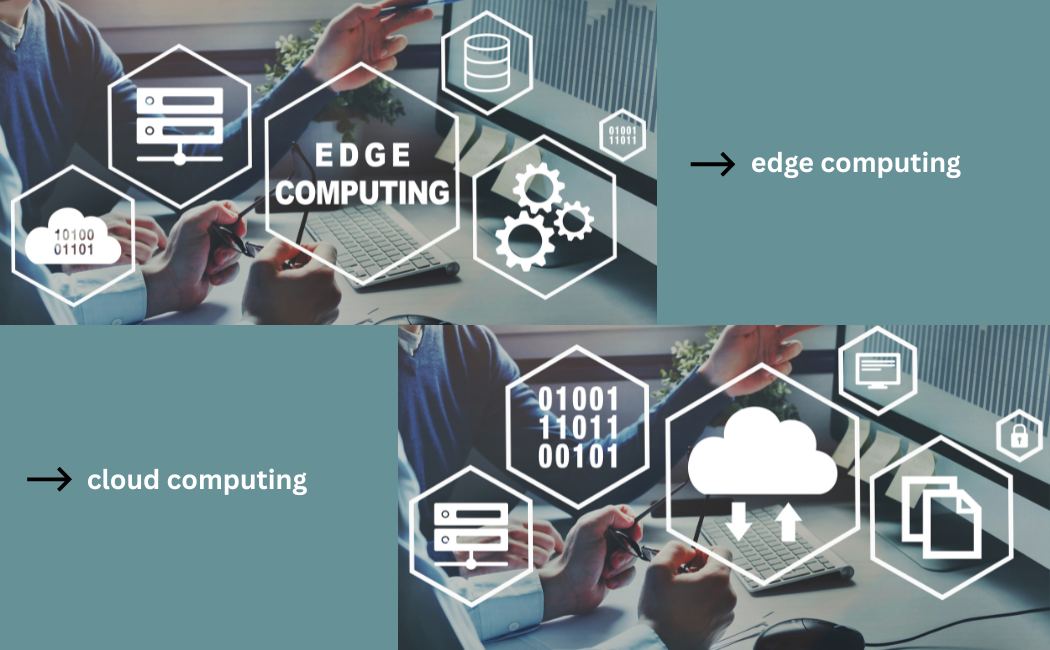
In today’s digital world, we hear two terms everywhere: edge computing vs cloud computing. But what do they truly mean? More importantly, how do they differ in real life? In this detailed guide, we’ll break down everything you need to know in simple language, use real‑world stories to explain complex ideas, and guide you step‑by‑step so that you walk away with clarity — and confidence.
Imagine this: You’re streaming your favorite movie. Meanwhile, thousands of miles away, healthcare machines are monitoring patients’ vital signs in real time, and factory robots are making split‑second decisions on a production line. Behind the scenes, cloud computing and edge computing power these experiences — but in very different ways.
With the explosion of data, devices, and real‑time decision requirements, organizations no longer ask “Cloud versus edge — which one is better?” Rather than choosing one, they ask, “How can we use both effectively?”
What Is Cloud Computing?
Cloud computing is a way of accessing computing resources—such as servers, storage, databases, and software—over the internet instead of owning and managing physical hardware yourself. Instead of buying expensive machines and maintaining them in your office, you rent computing power from large providers like AWS, Microsoft Azure, or Google Cloud. These providers run massive data centers around the world and deliver services on demand, allowing businesses to scale up or down easily, pay only for what they use, and access their systems from anywhere. In simple terms, cloud computing turns IT infrastructure into a flexible, on-demand service rather than a physical asset you must manage yourself. Learn more about cloud computing
What Is Edge Computing?
Edge computing is a computing model where data is processed close to the place where it is created instead of being sent to a distant cloud server for processing. In simple terms, it moves computing power “to the edge” of the network—near devices like sensors, cameras, machines, or smartphones. This approach reduces latency (delay), saves bandwidth, and allows faster decision-making. For example, a self-driving car processes sensor data inside the vehicle to react instantly, rather than waiting for instructions from the cloud. Edge computing is especially useful for real-time applications, remote environments, and situations where speed, reliability, and local data control are critical.
The Core Difference Between Cloud vs Edge
The core difference between cloud and edge computing lies in where data is processed and how fast decisions are made.
Cloud computing processes data in centralized data centers that may be located far from the user or device generating the data. This model is ideal for large-scale storage, big data analytics, AI training, and global applications due to its massive scalability and computing power. However, since data must travel over the internet, it can introduce latency (delay).
Edge computing, on the other hand, processes data close to the source—such as on a device, local server, or nearby edge data center. This significantly reduces latency, enabling real-time decision-making. It is ideal for time-sensitive applications like autonomous vehicles, smart factories, healthcare monitoring, and IoT systems.
In simple terms:
- Cloud = centralized power and scale
- Edge = local speed and instant response
Cloud focuses on big-picture intelligence and long-term analysis, while edge focuses on immediate action and operational efficiency. Modern systems often combine both to get the best of speed and scalability.
| Feature | Cloud Computing | Edge Computing |
| Location | Centralized in remote data centers | Decentralized close to the data source |
| Latency | Moderate to high | Ultra‑low (fast decisions) |
| Bandwidth Needs | High (data moves to the cloud) | Lower (data filtered locally) |
| Best for | Large‑scale analytics, long‑term storage | Real‑time processing, time‑critical apps |
| Cost Model | Subscription or pay‑as‑you‑use | Lower data transfer costs |
| Security Risks | Data travel risk | Localized data protection opportunities |
| Scalability | Virtually unlimited | Limited by local device capacity |
Why These Differences Matter Every Day
Let’s tell a story.
Anecdote: The Factory That Couldn’t Wait
A manufacturing company was struggling. Sensors collected millions of data points every hour from machines on the floor. Whenever something went wrong, the system would send the data to the cloud for analysis. But by the time engineers found the issue — minutes later — another breakdown had already happened.
Then they switched to edge computing. With processing happening right on the factory floor, alerts were instantaneous. This reduced downtime dramatically — saving money and preserving customer trust.
This example highlights the real value of pushing computing closer to where data is generated.
Benefits of Cloud Computing for Businesses
Cloud computing has transformed how businesses build, manage, and scale their technology. Instead of investing heavily in physical infrastructure, organizations can access powerful computing resources instantly over the internet. Here are the key benefits explained simply:
1. Scalability and Flexibility
One of the biggest advantages of cloud computing is the ability to scale resources up or down as needed. If traffic spikes unexpectedly, you can scale up capacity within minutes. When demand drops, you can reduce resources and save money. There’s no need to overbuy hardware “just in case.”
2. Cost Efficiency
Cloud operates on a pay-as-you-go model. Businesses avoid large upfront investments in servers, cooling systems, and maintenance. Instead, they pay only for the storage, compute, or services they actually use. This makes budgeting more predictable and reduces capital expenses.
3. Global Accessibility
Cloud services can be accessed from any location with an internet connection. Teams in different cities or countries can collaborate on the same applications and data in real time. This supports remote work and global expansion without building local data centers.
4. High Reliability and Availability
Major cloud providers operate across multiple regions and data centers. If one server fails, another takes over. This redundancy improves uptime and ensures business continuity.
5. Faster Innovation
Cloud platforms offer built-in tools for artificial intelligence, machine learning, analytics, DevOps, and automation. Instead of building everything from scratch, developers can use ready-made services to launch new products faster.
6. Automatic Updates and Maintenance
Cloud providers manage hardware upkeep, software upgrades, and infrastructure security. This allows internal IT teams to focus on strategic tasks rather than routine system management.
7. Enhanced Security Capabilities
Although security is shared between provider and customer, cloud vendors invest heavily in advanced security systems, encryption, and compliance certifications. For many businesses, this level of security is stronger than what they could implement on their own.
Benefits of Edge Computing
Edge computing enables data processing at or near its point of origin. Instead of sending everything to a distant cloud, data is processed locally—on devices, gateways, or nearby edge servers. This shift offers several powerful benefits.
1. Ultra-Low Latency
The biggest advantage of edge computing is speed. Since data is processed near its source, decisions happen almost instantly. This is critical for real-time applications like autonomous vehicles, industrial automation, robotics, and healthcare monitoring, where even small delays can cause serious problems.
2. Reduced Bandwidth Usage
Sending massive amounts of raw data to the cloud can be expensive and inefficient. Edge devices can filter, compress, or analyze data locally and send only important insights to the cloud. This significantly reduces bandwidth costs and network congestion.
3. Improved Reliability
Edge systems can continue operating even if internet connectivity is lost. This is especially important in remote locations such as oil rigs, ships, rural hospitals, or manufacturing plants. Local processing ensures operations don’t stop during network outages.
4. Enhanced Data Privacy
Because data can be processed and stored locally, sensitive information doesn’t always need to travel across public networks. This helps organizations meet data residency and compliance requirements while reducing exposure to external threats.
5. Better User Experience
Applications that rely on quick responses—like AR/VR, gaming, or smart devices—perform more smoothly when computation happens at the edge. Lower latency means faster load times and more responsive interactions.
6. Real-Time Automation
Edge computing enables instant decision-making for automated systems. For example, machines can adjust operations immediately if sensors detect anomalies, preventing damage and downtime.
Typical Use Cases Explained
Understanding theory is helpful — but real clarity comes from seeing how edge computing and cloud computing work in the real world. Let’s look at practical scenarios and break down why each technology plays a specific role.
Smart Manufacturing
In modern factories, machines are equipped with sensors that monitor vibration, temperature, speed, and output quality.
If a robotic arm starts vibrating abnormally, waiting even a few seconds could damage equipment or produce defective products. That’s where edge computing steps in. The data is processed right there on the factory floor, and the system can automatically stop the machine or adjust settings within milliseconds.
However, the story doesn’t end at the edge.
The summarized production data is then sent to the cloud, where advanced analytics identify long-term trends, predict maintenance schedules, and optimize supply chains across multiple plants.
So, edge prevents immediate failure. Cloud prevents future failure.
Autonomous Vehicles
Self-driving cars generate enormous amounts of data every second from cameras, radar, and LiDAR sensors.
If a pedestrian suddenly crosses the road, the vehicle cannot afford to send that data to a distant cloud server and wait for instructions. The decision must happen instantly. That’s why edge processing inside the vehicle handles object detection and braking decisions in real time.
At the same time, driving data from thousands of vehicles is uploaded to the cloud. There, machine learning systems analyze patterns, improve algorithms, and send software updates back to vehicles.
In simple words:
The edge keeps you safe right now.
The cloud makes the system smarter over time.
Healthcare Monitoring
In hospitals, patient monitoring devices track heart rate, oxygen levels, and blood pressure continuously.
If a patient’s vitals suddenly drop, nurses need immediate alerts. Edge devices analyze the data at the bedside and trigger alarms instantly. There’s no delay, no dependency on internet connectivity.
Meanwhile, the cloud aggregates patient data across departments or hospitals. Doctors use this data for deeper diagnostics, research, and predictive healthcare models.
Edge protects the patient in the moment.
Cloud improves medical outcomes in the long run.
Inventory and Supply Chains
Retailers and logistics companies operate across multiple warehouses and stores.
Local systems may track stock levels in real time at each location. However, the real strategic power lies in aggregating all that data centrally.
The cloud collects data from every branch, analyzes demand patterns, forecasts shortages, and optimizes delivery routes.
While edge systems handle local scanning and stock updates, the cloud drives company-wide strategy.
Why the Best Systems Blend Both
These examples reveal a clear pattern.
- Edge computing handles speed, real-time response, and operational continuity.
- Cloud computing handles scale, long-term intelligence, and global coordination.
If you rely only on the cloud, you risk latency issues.
If you rely only on the edge, you limit scalability and strategic insight.
The strongest systems combine both — creating a balanced architecture that is fast, intelligent, resilient, and scalable.
That is why modern enterprises no longer debate edge vs cloud.
They design systems where both work together seamlessly.
The Hybrid Reality: Cloud + Edge Together
In modern architectures, cloud and edge coexist — forming a continuum.
Here is how it works in practice:
- Data generated at the edge (like sensors on machines or devices in cars)
- Edge processes and filters important insights
- Summarized data moves to the cloud for deeper analysis
- Cloud performs long‑term storage, forecasting, and AI model training
- Updated models get sent back to the edge for faster decision‑making
This creates a cycle — one that combines speed and global intelligence.
A Step-by-Step Guide to Design Your Edge-to-Cloud Architecture
Designing an edge-to-cloud system is not about choosing technology first. It’s about deciding where intelligence should live. Some decisions must happen instantly. Others can wait. A good hybrid system balances both.
Step 1 — Identify Business Goals
Start with business needs, not tools.
Ask yourself: what truly requires real-time response? If delays could cause safety risks, production loss, or poor user experience, that workload belongs at the edge. For example, factory machine control or autonomous vehicle reactions cannot wait for cloud round-trips.
On the other hand, long-term data analysis, reporting, and AI model training can happen in the cloud. These processes are powerful but not time-critical.
Also consider compliance. If laws require data to stay local, edge or regional infrastructure may be necessary. Defining these requirements early prevents costly redesign later.
Step 2 — Classify Workloads
Now separate workloads based on their behavior.
Time-sensitive tasks go to the edge. These include IoT control loops, AR/VR rendering, real-time monitoring, and robotics. Edge reduces latency and allows instant decisions.
Large-scale analytics, storage, and global dashboards belong in the cloud. The cloud provides massive scalability and compute power that edge devices cannot match.
Some workloads are hybrid. For example, an edge device detects anomalies immediately, but the cloud trains improved AI models using aggregated data. This creates a continuous feedback loop between edge and cloud.
Step 3 — Build Smart Data Pipelines
Data movement is the backbone of hybrid systems.
Never send raw data blindly to the cloud. Instead, filter and compress data at the edge. Send only meaningful events, summaries, or alerts. This reduces bandwidth usage and lowers costs.
Use streaming technologies like Kafka or MQTT to move data reliably. These tools ensure messages are delivered even if connectivity fluctuates.
Also designed for offline scenarios. Edge systems must buffer data and continue operating even if the cloud connection drops. Autonomy is critical in remote environments.
Step 4 — Ensure Security Everywhere
Hybrid architecture increases your attack surface.
In the cloud, secure environments use identity management, encryption, and network segmentation. Follow the shared responsibility model carefully.
At the edge, security must be device-level. Use secure boot, hardware trust anchors, device certificates, and encrypted communication. Every device should authenticate before interacting with the system.
Adopt zero-trust principles. Never assume any device or network is automatically safe. Always verify.
Step 5 — Manage Seamlessly
Managing distributed infrastructure manually is not scalable.
Extend cloud-native practices to the edge. Use containers, automation, and infrastructure-as-code to ensure consistent deployments across locations.
A unified control platform simplifies operations. It allows centralized monitoring, workload deployment, compliance enforcement, and policy management across cloud and edge nodes. Without unified orchestration, complexity quickly becomes overwhelming.
Step 6 — Monitor and Optimize Continuously
Architecture is never “set and forget.”
Track latency, uptime, bandwidth usage, and cloud costs. Monitor both edge performance and centralized analytics.
Use feedback loops to improve AI models and system efficiency. The cloud can train better models, then push improvements back to the edge.
Optimization should also include cost control. Reduce unnecessary data transfer and right-size compute resources regularly.
Future Trends in Cloud Computing
Cloud computing is constantly evolving, and businesses need to stay ahead to remain competitive. Here are the key trends shaping its future:
1. Hybrid and Multi-Cloud Strategies
More companies are moving toward hybrid cloud or multi-cloud environments. Instead of relying on a single provider, they combine public clouds, private clouds, and on-premises infrastructure. This allows businesses to optimize costs, improve resilience, and avoid vendor lock-in.
2. Edge and Cloud Convergence
The future is hybrid computing, where edge and cloud work together. Edge devices handle real-time processing while the cloud provides centralized analytics and AI training. This convergence improves latency, scalability, and operational efficiency.
3. AI and Machine Learning Integration
Cloud providers are increasingly offering AI and machine learning services as part of their platforms. This trend enables businesses to analyze large datasets, automate processes, and gain insights faster than ever before. Cloud-based AI accelerates innovation without requiring heavy local infrastructure.
4. Serverless Computing Expansion
Serverless architectures enable developers to run applications without handling server management. The cloud automatically handles scaling, maintenance, and resource allocation. This approach reduces costs, simplifies deployment, and supports rapid application development.
5. Enhanced Security and Compliance Tools
As more organizations adopt the cloud, the demand for strong security increases. Future trends include zero-trust models, AI-driven threat detection, automated compliance monitoring, and advanced encryption techniques to protect sensitive data.
6. Sustainability and Green Cloud
Environmental concerns are driving energy-efficient data centers and cloud platforms. Providers are investing in renewable energy, cooling optimization, and carbon footprint reduction. Businesses adopting cloud solutions can also improve sustainability by reducing on-premises energy use.
7. Quantum Computing in the Cloud
Though still emerging, quantum computing is expected to be offered as a cloud service. This will allow businesses to experiment with quantum algorithms for optimization, cryptography, and scientific research without owning expensive quantum hardware.
8. Industry-Specific Cloud Solutions
Cloud providers are creating tailored solutions for healthcare, finance, manufacturing, and retail. These platforms offer pre-built compliance frameworks, analytics tools, and integrations specific to each industry.
In short, the future of cloud computing is hybrid, intelligent, secure, and sustainable. Organizations that embrace these trends can scale efficiently, innovate faster, and stay ahead in the digital economy.
Security and Compliance: What You Must Know
Security in hybrid systems is complex yet essential.
- Cloud systems typically handle large‑scale encryption and regulatory compliance across regions.
- Edge devices must be secured individually, which increases complexity.
Therefore, you need unified security policies that extend from central cloud systems to the edge.
This is where intelligent governance platforms shine — because they ensure that sensitive workloads never run in unapproved zones and maintain end‑to‑end compliance.
Cloud and Edge Are Not Competitors — They Are Partners
This is the most important mindset shift in modern IT architecture.
For years, businesses debated “cloud vs edge” as if they had to choose one. However, that thinking is outdated. Today, the real advantage comes from combining both intelligently. Instead of deciding which one is better, we should ask:
How can we make cloud AND edge work together?
The cloud is your strategic brain. It offers massive scalability, centralized control, global accessibility, and advanced analytics. It can process petabytes of data, train AI models, generate forecasts, and provide enterprise-wide visibility. In short, the cloud sees the big picture.
The edge, on the other hand, is your reflex system. It acts instantly. It processes data where it is generated. It keeps operations running even when connectivity drops. It enables real-time automation, whether in factories, hospitals, vehicles, or smart cities.
When these two layers collaborate, something powerful happens.
The edge handles immediate decisions — detecting defects, responding to sensor changes, triggering alerts. Meanwhile, the cloud analyzes aggregated data across regions, improves machine learning models, and sends smarter updates back to edge devices.
This creates a continuous intelligence loop:
- Edge collects and reacts.
- Cloud analyzes and optimizes.
- Improvements return to the edge.
- Performance gets better over time.
In other words, the edge ensures speed and autonomy, while the cloud ensures scale and intelligence.
Alone, each has limitations. Together, they complement each other perfectly.
Modern enterprises no longer build isolated systems. They design distributed ecosystems where cloud and edge function as partners — balancing performance, cost, security, and innovation.
The future is not centralized.
The future is not fully decentralized either.
The future is hybrid — intelligently connected, strategically distributed, and continuously optimized.
FAQs
What is the difference between edge computing and cloud computing?
Edge computing processes data close to the source for real-time decisions, while cloud computing handles large-scale storage, analytics, and long-term insights in centralized data centers.
Which applications are best suited for edge computing?
Time-sensitive applications like autonomous vehicles, smart manufacturing, AR/VR, IoT devices, and healthcare monitoring benefit most from edge computing.
Why should businesses adopt both cloud and edge computing?
A hybrid approach combines the speed and local autonomy of edge computing with the scalability and global intelligence of cloud computing, reducing costs and improving performance.
How does cloud computing help with business scalability?
Cloud computing provides on-demand access to servers, storage, and analytics tools, allowing companies to scale resources up or down easily and pay only for what they use.
What security measures are needed for a hybrid edge-cloud system?
Hybrid systems require device-level security at the edge, encryption, identity management in the cloud, and unified governance platforms to ensure compliance and protect sensitive data.
Conclusion
The future of technology isn’t about choosing either cloud or edge — it’s about creating a hybrid system that combines the strengths of both. By understanding edge computing vs cloud computing, businesses can build faster, more responsive systems, cut unnecessary costs, and support real-time innovation. This approach enables companies to stay ahead in a competitive digital landscape. With the right strategy and tools in place, you’re not just keeping up with technology — you’re leading the way.